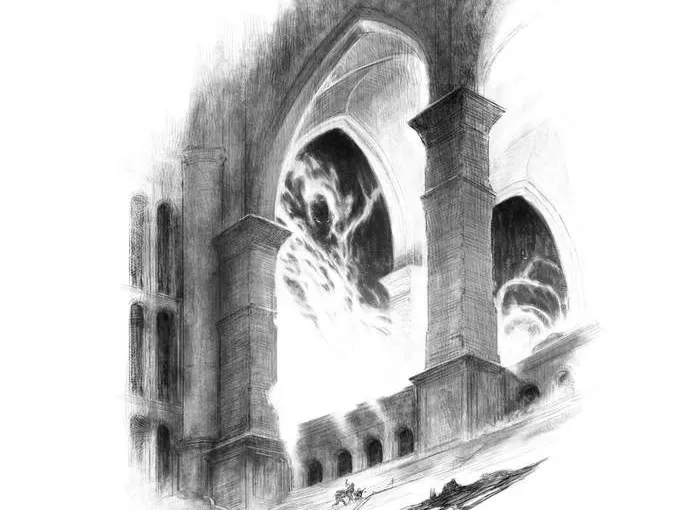
The Last Dwarves of Kan Karak
Table of Contents
Design Notes
As I built a subplot for the mountain dwarves briefly mentioned in Red Hand of Doom, I wanted to take the time to build out a history for the dwarves in my local area. The adventure, inspired by Saintheart’s RHoD Hammerfist Hold expansion required two things:
- A large dwarf stronghold in the mountains ruled by a single dwarf.
- A small, abandoned dwarven holdfast nearby.
But this local area is designed to have all the familiar tropes of classic adventuring fantasyland. For dwarves, that meant a few things:
- A large abandoned dwarven megadungeon - everyone needs a Moria to explore!
- A lost dwarven mine and forge, to run my version of the classic adventure The Forge of Fury.
- A war between the dwarves and goblins/orcs beneath the mountain! This is to explain a history of racial emnity, and to give the same feel as Tolkien’s work.
- A feeling of lost grandeur and regression. Classic fantasy is rooted in the idea of lost grandeur and ancient empires, especially as humans become the dominant species. But dwarves long for greater days ahead!
My players are mostly uninterested in lore until it solves one of their problems, so I usually distribute this lore as a handout once a player starts asking about whether the dwarves can help them.
Lore
Durnek’s Murder

Dwarvish Armor by Turner Mohan
Eleven centuries ago, Ur-Thane Durnek Stormbreaker of Clan Dori built the Highroad (now called the Dwarfroad by the humans of Rask) and ruled the Dwarven Kingdom of Kan-Karak (“Three Peaks”) in the Wyrmsmoke mountains. Nearing the end of his life and fearing a war, Durnek dak Dori cooperated with Emperor Trajan Alorius II and ceded control of the lowlands and valleys to the humans in the Treaty of Kal-Baram.
Furious and shamed by this concession, his cousin Morndrim of Clan Morn proclaimed Durnek unfit to rule, murdered him at the Council of Thanes, and usurped the throne.
The Founding of Kal-Drukhar
Durnek’s youngest child, Du-Thane Dazran dak Dori, escaped Kan-Karak with a small retinue of followers. Guided by the Ordstar1, the young dwarf prince discovered a great system of caverns beneath the Stone Tooth, shining with the radiant light of precious metals and gems.
There Dazran and his followers founded the hidden underground forge-city of Kal-Drukhar (“The Glitterhame”) where Dazran became one of the great dwarven smiths, crafting works of unparalleled quality and constructing Zabuul-Dazar (“the Runeforge”).
Dazran’s Vengeance
Laboring tirelessly in secret, the dwarves of Kal-Drukhar forged weapons and armor to retake a kingdom. Four decades after the death of Durnek, Dazran emerged from hiding to rally the clans still loyal to his father and the realm fell into civil war.
To break the unbreakable doors of their kin’s underground fortresses, the dwarves brought forth the last of their great weapons from the First Age. The mountains shook, the Wyrmsmokes vomited fire, and the great dwarven keeps were reduced to slag.
Eventually Dazran reclaimed the throne and Morndrim was exiled to a holdfast at the peak of Mt. Norn until his death. Unlike the other dwarven kings, whose tombs lie hidden deep in the Wyrmsmokes, Morndrim was buried below the holdfast in a comparatively simple tomb.
But the Kingdom of Kan-Karak had been irreparably ruined. The indestructible halls of the dwarves had been brought to rubble by the thunderblasts and runic lightning of their own mighty siege engines.
The Fall of Kal-Drukhar
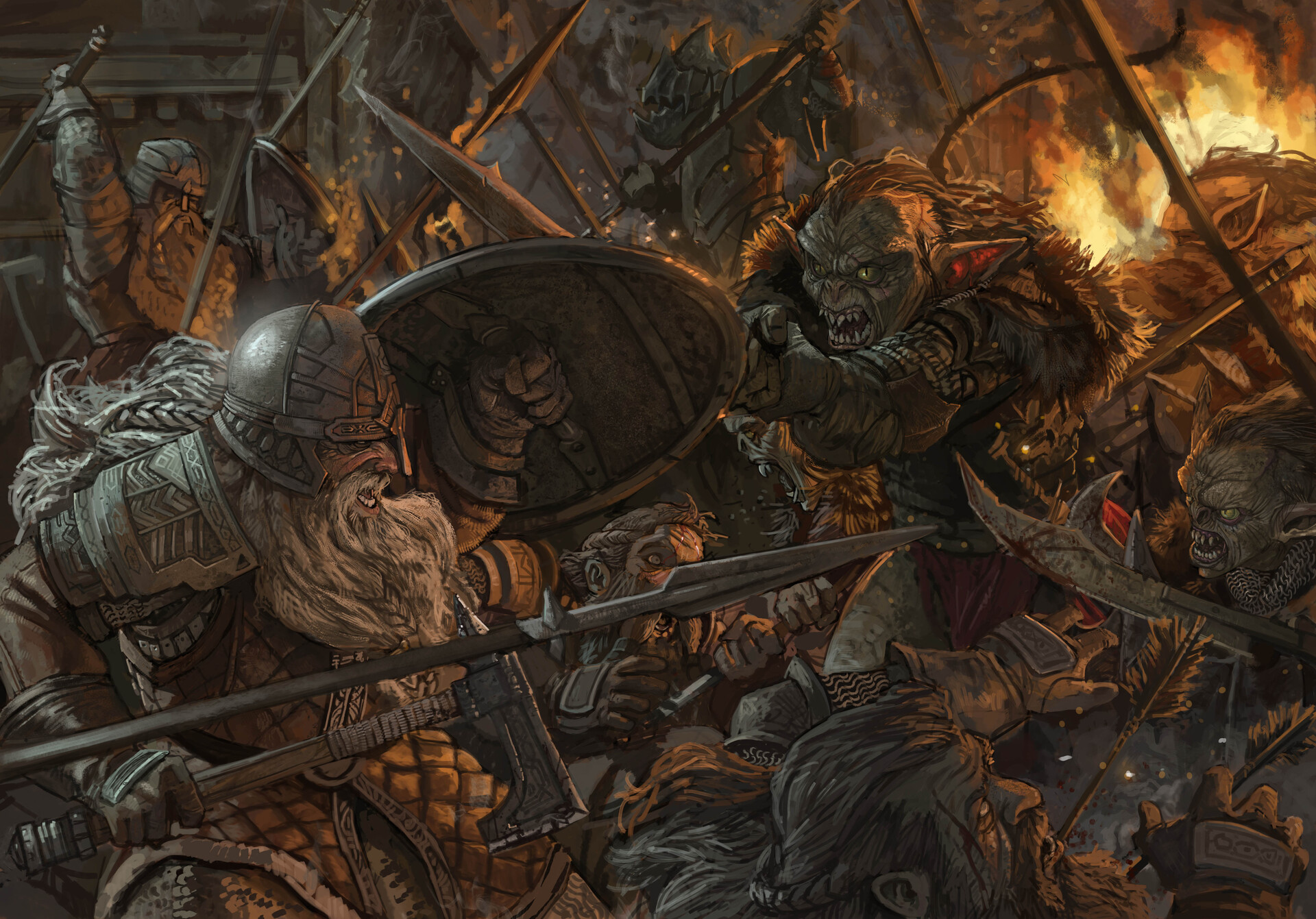
The Last Stand by Ignacio Corva
The bloodied dwarves found themselves weaker than the goblin and orcish tribes they had once crushed. A vicious war that would last eighteen years erupted in the deep caverns and high mountain passes of the Wyrmsmokes.
In the chaos, the enemies of Kan-Karak discovered Dazran’s hidden stronghold and a great army marched on Kal-Drukhar. The hard-fought siege lasted five years, but eventually the besiegers tunneled through the dwarven defenses. Storming the mythical forge-city, they put all within to the sword. The location of Kal-Drukhar, a closely guarded secret, was lost. Dazran dak Dori was killed, ending the line of Dori.
The leaderless and defeated dwarves fled south and secured themselves amidst the few remaining habitable holts of their fallen kingdom, where they reside today. But the memory of Dazran’s Vengeance (or the Smith’s War) became legend and the extraordinary blades the dwarves forged in anger are still found across Rask.
Deploying in your game
Lore feels fairly useless and indulgent if it doesn’t provide some immediate enrichment at the table. Usually this comes in the form of a feeling of depth and verisimilitude - even though the players don’t actually ever learn the lore, they become more invested just by knowing it exists and is “real”.
The popular adventures Lost Mine of Phandelver and Forge of Fury can both have their titular mines/forges substitued with Kal-Drukhar, both have worked well as seeds in my local area.
Magical treasure from other adventures can be of dwarven make, forged in the fires of the Runeforge, and stamped with the smith-mark of Dazran dak Dori (three dwarvish “D” runes arranged in a triangle, for Dazran, Durnek, and Clan Dori).
I’ve used the following scenes and characters to provide the player-facing surface that hides deeper investment:
Mim (NPC encounter)
Mim (secret treasure hunter)
A young, bright eyed dwarf woman with a missing front tooth. Travelling alone. Dresses in mining clothes, covered by a cloak against the elements. Her large pack holds surveying tooks and spelunking equiment.
Demeanor: Careful not to reveal her mission to a non-dwarf, keeps to herself, lonely. Speaks politely but firmly, with a heavy dwarvish accent.
Desires: To find the location of Kal-Drukhar and rekindle the Runeforge, revitalizing the local dwarves. Grew up starry-eyed hearing the tale of Dazran.
Hooks:
- Local human miners eye Mim suspiciously from across the tavern taproom. Once sufficiently drunk, they will get up and intimidate Mim into leaving town, fearing she plans to open a dwarvish mine nearby.
- Mim approaches the PCs and will pay them to describe the features (mountains, hills, rivers) of the local area to her. If you are looking to move players towards an adventure out in the wilds, she can offer to pay the PCs to survey and map that area.
Map of the Stone Tooth (Treasure/Item)
A goblin/orc treasure horde contains a dwarvish map to Kal-Drukhar, plundered during its fall. Now it is used to return to the small hideout the orcs have established in the upper levels of the mountain fortress.
Dwarvish Map
Preserved in sheath of hide, this detailed dwarvish map has been crudely labelled and scrawled upon in goblish. It makes clear the location of a mountain hideout of glittering caves on the slopes of a rocky hill called the “Stone Tooth”
Resale Value: A dwarf who recognizes the provenance of the map will pay handsomely for it, and seek to hide the (re)discovery of Kal-Drukhar from other species.
This location is detailed further in the adventure The Forge of Fury.
Obelisk of the Treaty of Kal-Baram (Set Dressing)
The Treaty Pillar
A dwarven obelisk stands at the wayside of a mountain road. A stack of coins sits atop its peak.
The Obelisk: A weathered dwarven obelisk, 10ft high and 4ft square, carved with images depicting Ur-Thane Durnek dak Dori signing the Treaty of Kal-Baram with the representative of Emperor Trajan Alorius II. On close inspection, the carvings were defaced with the dwarvish runes for “traitor” before being cunningly repaired many years ago (the damage occurred during the reign of Morndrim; the restoration occurred after Dazran’s victory).
Good Luck Coins: A small pile of dwarvish coinage is stacked precariously at the peak of the column: good luck charms placed by travellers.
A useful and simple addition to any mountain pass, either as brief interactable set dressing during a narrative journey or as the location for some other event (like a combat or campsite).
Forbidden Path (Cultural Aversion)
A dwarf NPC refuses to travel along a certain mountain route, claiming it is bad luck and haunted — it is the pass where Durnek’s retinue was ambushed and killed by his cousin Morndrim.
Razrad Tarn (Location)

The ancient site of a famous battle! If you’re looking to pad a session, add some dwarf ghost/wraiths that wish for their clan ceremonial hammer to be retrieved from the depths (see The Water below).
Razrad Tarn
A still mountain lake that runs for half a mile along a mountain path. A thin mist veils the surface of the tarn in the morning.
Shoreline and Bones: The rocky shoreline is made up of smooth pebbles mixed with fragments of bleached bone.
The Water: Icy cold; deadly to swim in without a way to warm up quickly afterward. The bottom (15ft down at deepest point) is covered with intact dwarvish, goblin, and orc skeletons still carrying badly rusted armor and weapons (from centuries underwater). Some items have survived the ages:
- A golden ceremonial hammer of Clan Nenn emblazoned with a trio of mushrooms (dwarves will pay triple for it).
- A +1 shield and +1 shortsword of mithril each stamped with the smith-mark of Dazran dak Dori (three dwarvish “D” runes arranged in a triangle, for Dazran, Durnek, and Clan Dori).
- A vial of ithildin, the enchanted ink used by dwarves to write moon-letters invisible to the naked eye except when viewed under moonlight.
History: Razrad Tarn was the location of the largest battle between dwarves and orcs/goblins during the great war that razed Kal-Drukhar. It was here the dwarves were defeated.
Footnotes
-
I like leaving room for a story similar to Durin’s Crown. ↩